|
Dear listeners and keepers of Estonia’s independence!
I wish you a memorable and fruitful Resistance Day!
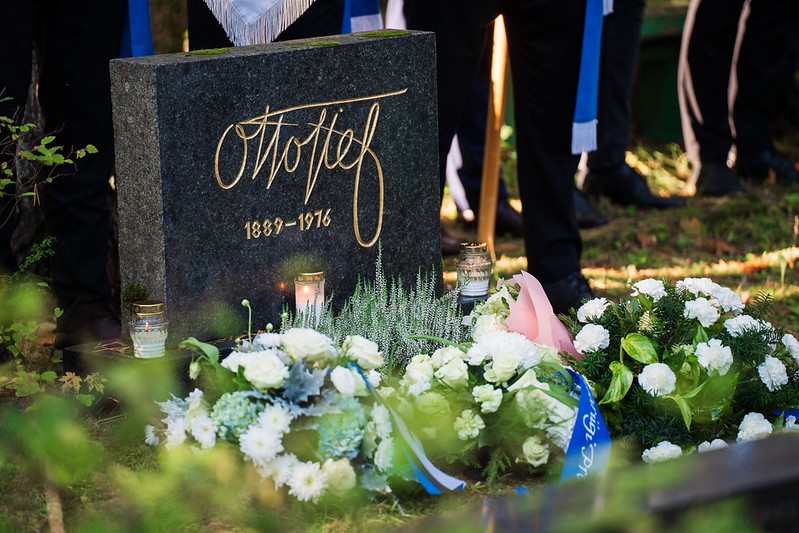
Gathering here at the grave of Otto Tief on 22 September every year is a beautiful gesture to recognise all those people who defended our independent and free Estonia through various forms of resistance until the end – both in the sense of their death and until the end of the occupation of Estonia.
As we know, the domestic organisation of Estonia, especially democracy, was very fragile before the Second World War, and the brutal battles of that war, which caused suffering for millions, mercilessly destroyed our country and people. On 17 June 1940, Estonia was occupied by the Soviet Union, the predecessor of Russia, which is now waging a war of aggression against Ukraine. This was preceded by the overthrow of our constitutional government, including Professor Jüri Uluots, and followed by the installation of the puppet government of Vares-Barbarus, fraudulent elections of the Estonian legislative body – the parliament –, the neutralising of the Estonian national structure, including our defence forces, and the arrest of the leaders and spokespersons of our people.
We might ask – did all of this happen without resistance? Fortunately, not at all – we stood up to protect our morals, people, and state order! Examples of this include the battle held on Raua Street by the Signal Battalion, the hiding of the state seal in the attic of the Kadriorg administrative building by officials, the refusal of our diplomats to return to their occupied homeland, and the attempt of our political elite to disrupt the fraudulent parliamentary elections of the occupying power. All these and many other public, less public, as well as completely secret steps were taken for independent Estonia to resist the occupier.
However, this resistance was not enough. At least at first. With systematic and energetic consistency, the occupying power began to destroy those fighting for a free Estonia: they targeted state leaders and officials, members of the defence forces, political leaders, local government figures, law enforcement officers, intellectuals, journalists, entrepreneurs, etc. This included Jüri Uluots, Otto Tief, and members of his government.
On 18 September 1944, the day after the withdrawal of German military forces, Jüri Uluots, prime minister in the role of president of the last pre-war government, appointed the new government of the Republic of Estonia. The government led by Otto Tief came together on 19–21 September 1944 in the current Eesti Pank building. On 22 September 1944, units of the Red Army occupied Tallinn, the blue-black-white Estonian flag in the Pikk Hermann Tower was lowered, and the red flag of the occupation was raised in its place. The resistance began.
The resistance of the Estonian people to the occupying power mainly took the form of armed combat by the Forest Brothers, Finnish Boys, and units organised by ex-admiral Pitka, but it was also expressed in the organised underground activities of students and dissidents – those who thought differently. The selfless and brave actions of Jüri Kukk, Enn Tarto, Mart Niklus, Lagle Parek, and other dissidents in confronting the occupying power is an act of heroism.
In the war between totalitarian regimes, the front shifted across Estonia twice. The terror and destruction forced our people to leave their homes. More than 80,000 Estonians fled to the West. On 12 January 1953, prime minister in the role of president August Rei appointed a government led by Johannes Sikkar. It was the first of the five governments in exile, which, together with diplomats, maintained the continuity of the Republic of Estonia established in 1918 in the free world and consistently demanded the non-recognition of the occupation of Estonia by Western countries. War refugees, as well as the formation of a refugee government, are part of the resistance.
It is important to emphasise that Estonia never surrendered and resistance in various forms lasted until the restoration of the independence of the Republic of Estonia in 1991.
What can we learn from this for our present and future? We have to show gratitude to and admiration for every one of those resistance fighters. What else? Can we manage our state affairs better today than in 1940? Do we have any lessons to learn from history? Yes to both: I can say that Estonia as a country is better prepared than ever to fight for its independence. I also know that we have already learned many lessons from history, whether on democracy, common Western values, international and regional cooperation, civil society, or diversity.
We cannot help but think about Ukraine and the occupation there on our Resistance Day. We can confirm from our experience that it is very important to fight for your country and values at every level – at the level of the state, citizens, and every individual. Unfortunately, this also means sacrifices. While they are resisting, it is the duty of other democratic countries not to recognise the occupation. We also have an obligation to help those in need. That is why we have to help Ukraine win!
The memory of Otto Tief and other resistance fighters requires us to fight for our country, to improve ourselves every day, and to make the world a better place for future generations!
See pictures from the celebration of Resistance Day here
|