
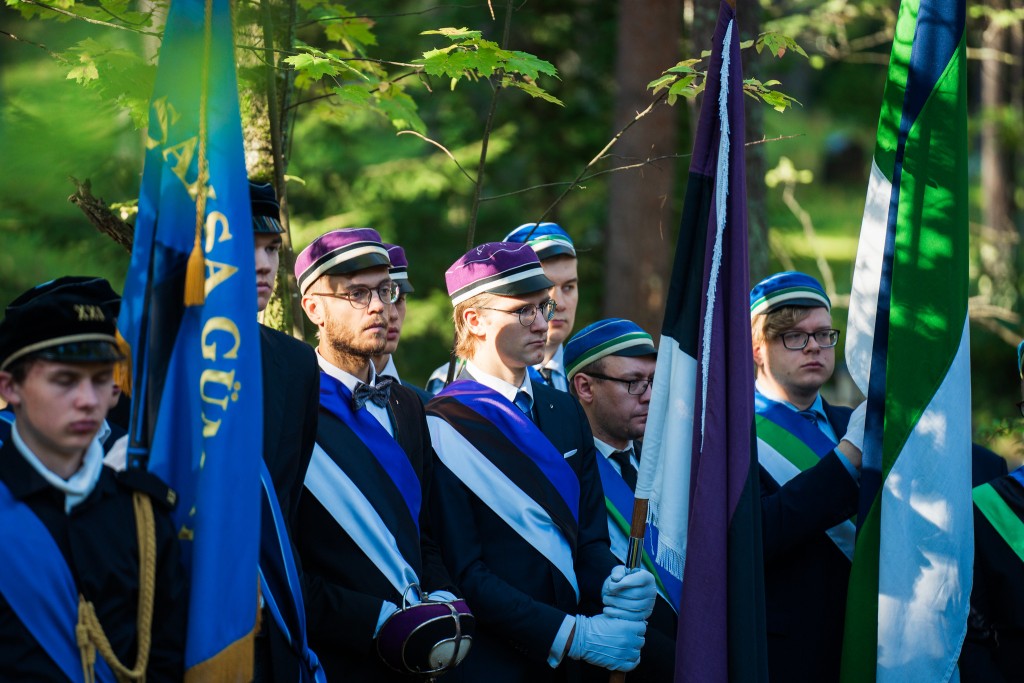
Attending the unveiling were current and former secretaries of state Taimar Peterkop and Uno Veering, representatives of the Rapla County Association of Freedom Fighters and Rapla municipality, residents of Sikeldi village, students from Jakob Westholm schools, members of the Konstantin Päts Museum NGO and Johan Laidoner Association and flagbearers from Tallinn School no. 21.
Helmut Maandi was appointed Secretary of State by Estonia’s last pre-occupation prime minister Jüri Uluots on 18 September 1944. This means that Maandi recognised Otto Tief’s government and published a list of its members in the State Gazette. When the Tief government held its final cabinet session in Põgari on 22 September that year, the decision was taken to leave for the free West. Unfortunately, the launch that had been called in from Sweden failed to arrive by the agreed time, so to avoid collective arrest the members of the government had to depart instead from Puise. Maandi, however, remained behind, and when the launch finally arrived he was the sole passenger to depart on it for Sweden. With him he took the only surviving copy of the State Gazette serving as documentary evidence of the formation of Tief’s government and thus as a basis for the legal continuity of the Republic of Estonia. Clashes with the subsequent head of government August Rei led to Maandi’s dismissal on 15 January 1945, but Rei reinstated him to the position on 18 December 1949. Maandi then served as Secretary of State until 11 January 1953.
The following is the speech given by Secretary of State Taimar Peterkop upon the unveiling of the information board.
Esteemed Maandi family, former secretary of state, municipal mayor, residents of Sikeldi, students, friends,
A memorable – and hopefully also educational – Resistance Day to us all! Resistance to the occupying forces and the fight for a free Estonia began on 17 June 1940. At the time, the occupying force threatening us was the Soviet Union, the antecedent to today’s Russia, which is currently waging a war of aggression in Ukraine. The first phase of resistance ended on this very day 79 years ago when it became clear that although the government of Otto Tief, formed only a few days earlier, had the will to defend Estonia, it lacked the means to do so. As such, its members decided to continue the fight for their sovereign nation, which had been established on the basis of the right to self-determination in 1918, in the free world.
The previous day, 21 September 1944, the government had decided to relocate itself from Tallinn to Lääne County. The Red Army had broken through the lines along the Emajõgi River four days previously and were moving steadily towards the capital in spite of the resistance offered by those fighting for the independent Estonia. Nor was their lack of weapons countered by 72-year-old Admiral Johan Pitka’s decision to come out of retirement and return to his homeland from Finland to defend Tallinn. As the government retreated to the west of the country, it attempted to direct the scattered and conflict-ravaged Estonian units so as to prolong the armed resistance for as long as possible, but firepower proved lacking.
At this point I would like to stress that the decision of the Tief government to retreat from Tallinn and later to emigrate cannot in any way be construed as surrender. On the contrary: these were acts of resistance. How easy it would have been for the government to board a boat in Tallinn and set sail for Sweden or Finland. But no – until the last moment they did what they could to keep a tiny but nevertheless factually existent part of Estonia under their constitutional control. Now, with the benefit of hindsight, we can see that doing so sealed the fates of almost every member of that government.
Just three of the 11 men who served on Tief’s government escaped the repressions of the occupying force: Minister of Foreign Affairs August Rei, the most senior member to do so; Minister of Trade and Industry Rudolf Penno; and Minister of Justice Johannes Klesment. From the point of view of international law, and indeed from that of the constitutional order of Estonia, this was almost enough to ensure the legal continuity of our republic. Why ‘almost’? There exists the principle that ex iniuria ius non oritur, which is to say a right does not arise from wrongdoing.
The issue was that legal constructs alone were not enough: facts were needed to prove that the people of Estonia, or their representatives, clearly wished to continue running their own country. This is where Secretary of State Helmut Maandi comes into play.
As we know, Maandi was the only person to make it to the free world in possession of a copy of the State Gazette setting out the decisions of Professor Uluots, including the appointment of Otto Tief’s government. He was also able to reconstruct – albeit only from memory and once in Sweden – the declaration approved by Tief’s government announcing the restoration of Estonia’s independence and the formation of said government, declaring Estonia neutral in the ongoing war and protesting against the invasion of the Red Army. In both cases it was Maandi who helped prove to the world the ongoing resistance of the Estonians to the occupying forces.
The importance of the role played by Maandi in publishing the decisions of the constitutional government is impossible to overstate. It is the uncompromising example he set that compels and inspires me to arrange for the prompt and efficient fulfilment and announcement of the wishes and decisions of the government on a daily basis.
Since Otto Tief himself was arrested in Estonia on 10 October 1944 and Jüri Uluots died at the age of 54 in Stockholm on 9 January 1945, the oldest surviving member of the cabinet, August Rei, assumed the post of Prime Minister and Acting President. Tief’s government continued to operate de jure until the declaration of the first official Estonian government-in-exile in Oslo on 12 January 1953. This year marked the 70th anniversary of that milestone.
Resistance to the red evil at the level of the government-in-exile was anything but rosy, with insurmountable clashes of personalities and worldviews, a dearth of resources and the limited political freedoms extended to émigrés in Sweden all proving problematic. The dispersed nature of Estonia’s refugee community did not simplify matters either. But despite all this, the nation’s continuity persisted: Rei appointed first the Sikkar and later the Warma, Warma-Kint, Kint-Mark and Mark-Penno governments. The final Prime Minister and Acting President of the government-in-exile, Heinrich Mark, handed the reins of constitutional and uninterrupted state governance to the newly elected 7th parliament of Estonia on 7 October 1992. With this act, the government-in-exile ceased to function.
Standing here today by the ruins of Sikeldi Mill, I would like to say to everyone listening, young and old alike, that the world is in our hands. Helmut Maandi, the son of a miller from right here in Rapla County, was single-minded in performing his civic duties – and in doing so, he changed the world. Because without those actions, there would have been no government-in-exile, the Republic of Estonia would not have been able to be restored on the basis of legal continuity in 1991 and Estonia would not be the same as the country we live in today. In short, we all have our roles to play as citizens and as family members. We must all strive to achieve our goals, however realistic or otherwise they may seem. May Helmut Maandi’s story be an inspiration to us all.

