
""
2.7.1. Local Governments in the Green Transition
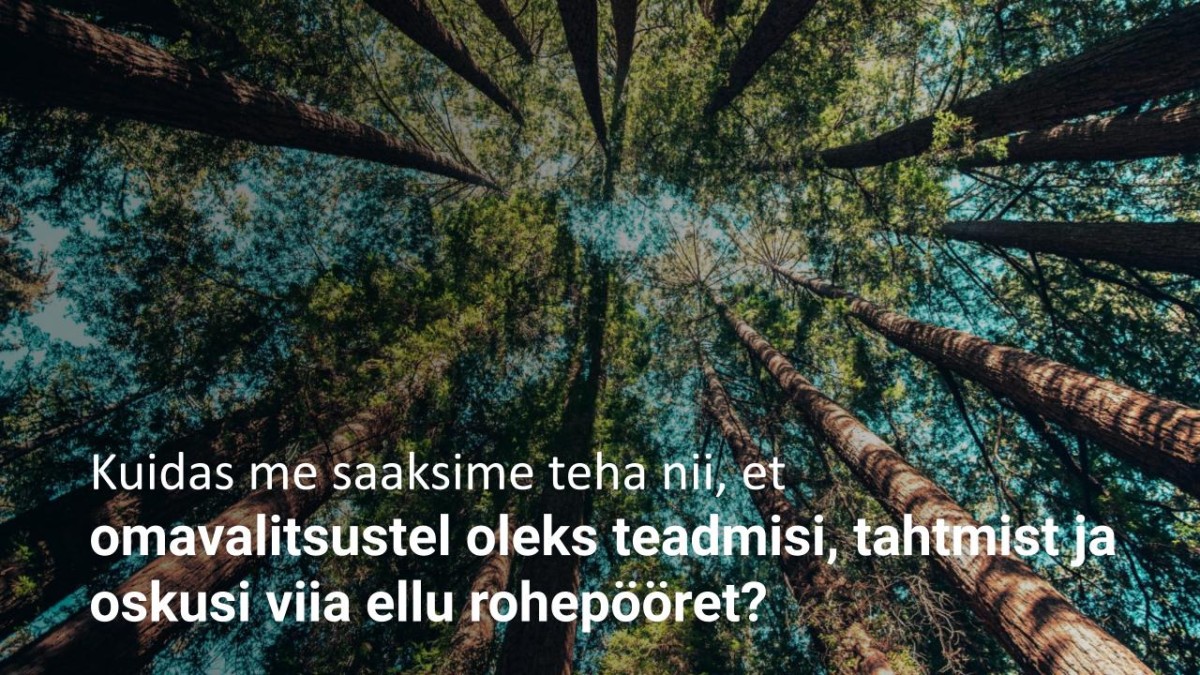
How can we ensure that local governments have the knowledge, motivation and skills needed to implement the green transition?
The organisations involved in the discussions were the Environmental Investment Centre, the Ministry of Finance, the Environmental Board, the Environment Agency, Tallinn University of Technology, the Ministry of Economic Affairs and Communications, the Association of Estonian Cities and Municipalities, Elva Rural Municipality and the City of Tartu.
the project revealed that:
- The substance of the green transition and the role of local governments in it remain unclear, including their roles as role models and leaders, supervisors and facilitators.
- There is a lack of understanding about where to begin, how to set priorities, how to measure the results of activities and how to secure funding. The many levels of municipal governance and the broad range of services provided also make the transition difficult to interpret and implement. Cooperation with universities and support organisations could create greater value.
- Even today, the work of municipal environmental specialists covers a very broad range of topics and is filled with everyday responsibilities, from snow removal and stray dogs to procurement, permits and supervision.
the programme resulted in the following solution ideas:
- R-Club: A network of municipal decision-makers and key stakeholders that would provide inspiration, a sense of solidarity and a platform for developing joint projects.
- Green Monitor: Based on the principle that “what gets measured gets managed”, funding could be allocated through a positive element of competition to encourage progress towards environmental and climate objectives. The broader aim is to support planning documents, projects and decisions based on data.
- Green Support Team: Municipalities that are less advanced need support and a personalised approach. Experts from research institutions and central government, together with mentors from more advanced municipalities, could help them understand the issues, establish an appropriate governance model and take the first steps towards systemic change.
- The design sprint also generated ideas that could be transferred to other fields, such as green public procurement, adapting university micro-credentials and curricula to the needs of municipal environmental specialists, and addressing waste management as a pressing and relatively achievable area for improvement. These ideas are being pursued through separate initiatives.
AS of june 2024, the developments are at the following state:
- The R-Club has met five times, and 17 local governments have formally joined. Cooperation has also taken place with the Smart Cities Network of Southern Estonia. The club’s steering group includes the Association of Estonian Cities and Municipalities, the Environmental Investment Centre, the Ministry of Climate and the local government holding the rotating chairmanship. Tallinn chaired the club in 2023, followed by Tartu in 2024–2025. The club mainly relies on in-kind contributions, including the provision of meeting spaces and the involvement of opinion leaders. Valuable synergies have also resulted from adding a local government coordinator to the Ministry of Climate’s Green Reform Department and, more broadly, from the horizontal coordination of the green transition following the establishment of the Ministry of Climate.
- The development of the Green Monitor has been integrated into workstreams related to the Climate-Resilient Economy Act, the green transition, and the refinement of indicators used in climate and energy plans. This is helping to establish clearer directions and outputs for improving environmental indicators and making broader use of data. When designing new support measures, the Environmental Investment Centre can open the topic for discussion once the key indicators and policy areas have been more clearly aligned.
- The Green Support Team was not launched in its originally planned form. However, the Ministry of Climate has appointed a dedicated local government coordinator who has begun providing systematic support. A team-based support model may still be introduced in the future. Advisory arrangements have also emerged organically with several small and proactive local governments, helping them apply for direct EU funding aimed specifically at less advanced municipalities.
- The design sprint also generated ideas that could be transferred to other areas, including green public procurement, adapting university micro-credentials and curricula to better reflect the needs of local government environmental specialists, and addressing waste management as a pressing area where relatively quick progress could be achieved. These ideas are being pursued through separate initiatives.
Project duration: 2022
The project was implemented as part of the Innovation Programme.
Read more (in Estonian):
Last updated on 09.09.2025
Activities and projects in the field of innovation are funded under the European Union Cohesion Policy 2021–2027 measure.
Last updated: 23.02.2026

