
""
2.9.1. Safer Nightlife
Could the state design a service related to illegal activity?
Yes—when it is a matter of life and death. Drugs have become a significant part of partying and entertainment, and their use is extremely difficult, if not impossible, to prevent. If we cannot stop it, we must work to reduce the harm associated with it.
With this starting point, the project—working under the title “Safer Nightlife”—participated in the 2022 Public Sector Innovation Programme. The core team included representatives of the National Institute for Health Development, the Police and Border Guard Board, and the HALL techno club. The team also collaborated with numerous event organisers and nightclubs. The project mentor from the Innovation Team was Helelyn Tammsaar.
As part of the project’s background research, a wide range of interviews were conducted with event organisers, police officers, club and bar staff, as well as people participating in nightlife. The team also carried out participant observations in Tallinn’s nightlife scene and at festivals with very different profiles.
Key insights:
- Society expects people to exercise self-control, yet the interviews clearly showed that nightlife is precisely where people want to do the opposite. They seek opportunities to relax and speak on "recharging" "getting away" "freedom" and "re-setting". Recent crises have played a role in this, as have growing mental health challenges. Nightlife is therefore a setting in which people don't want to restrain themselves.
- It is not that people are entirely unaware of how to avoid harm. However, when intoxicated, their perception of risk decreases and they are more likely to engage in risky behaviour.
- A person who has consumed too much alcohol and/or drugs may feel ashamed about losing self-control. People who begin to feel unwell often withdraw from others and isolate themselves, making it much harder for their need for help to be noticed—even by their friends. It is alarming how common it is for venues simply to put people who are severely intoxicated and unable to care for themselves out onto the street.
- A major problem is that people do not seek help themselves. In the case of drugs, this is often driven by fear: because the substance is illegal and the possession and use of drugs are punishable in Estonia, people face a difficult dilemma about whom they can safely turn to for help. What should I tell them? What if I get into trouble?
In summary, a paradox emerges: people are not afraid to use dangerous and impure substances, yet they are afraid to ask for help or call for assistance.
solution: night fairies
Nightlife involves a range of roles and positions, such as door staff, security personnel and bartenders. However, people in these roles often lack the knowledge needed to recognise signs of different types of drug use and the skills to respond appropriately. They may also not always see it as their responsibility to help partygoers who, as a result of substance use, have placed themselves or others in danger
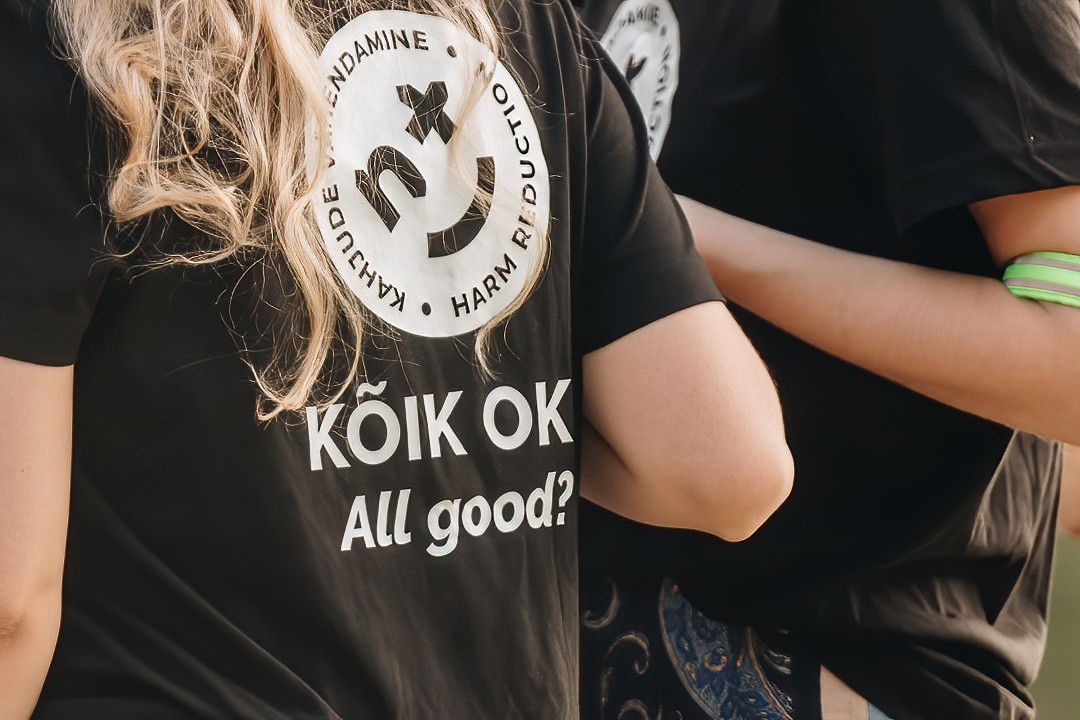
Night Fairies are a new role in nightlife designed to fill this gap. They provide discreet support and assistance to people taking part in nightlife and build trust so that people feel more comfortable speaking openly about these issues and asking for help when needed. Night Fairies can be recognised by T-shirts bearing the words “All good?”. At festivals, they operate from a dedicated tent and use a highly visible “periodic table” style information matrix showing how different substances interact and which combinations should be avoided altogether.
Night Fairies are volunteers who have completed a training programme developed by the National Institute for Health Development. They also take part in follow-up training, which continues to be developed jointly. As of 2024, Night Fairies operate as a non-profit organisation. The service is available year-round in Tallinn and Tartu, and the network includes around 40 trained volunteers. Long-term partners include HALL nightclub and the Stiilipidu event series. The initiative also takes part in summer festivals, including I Land Sound, Solstitium, KÕU, Valga Glow, Bling and Beach Grind. Cooperation has also begun with the City of Tallinn
Solution: Providing Drinking Water
As part of the project, event organisers and larger local authorities were engaged to promote the provision of free drinking water at parties and festivals across Estonia. To support this, a behavioural science-based toolkit was developed, offering a range of options for making drinking water easier and more appealing.
Read more (in Estonian):
awards and recognition
- In a public vote organised by ERGO insurance ja Postimees Night Fairies was named the most impactful prevention initiative of 2023.
- At the 2024 Estonian Student Awards, the initiative received the Social Impact Initiative of the Year award.
night fairies in the media
Kes on ööhaldjad ja kuidas nad kirevas ööelus inimesi päästavad? | Kanal2, Õhtu
Pidudel narko- ja alkoholijoobes inimesi abistav ööhaldjas Marit: levib ohtlik väärarusaam, et MDMA-st pole võimalik üledoosi saada | Õhtuleht
Ööhaldjad turvalise ööelu jaoks | ERR
Noore mehe narkosurm Beach Grindil vapustas sel suvel kogu Eestit | TV3, Laser
Kas sul on kõik hästi? Ööhaldjad hakkasid suvel festivalihaldjateks, et hoida ära naokksurmasid | EPL
Ööhaldjad - turvalisema ööelu kindlustajad | teeviit.ee
Project duration: 2022
The project was implemented as part of the Innovation Programme.
Last updated on 09.09.2025
Activities and projects in the field of innovation are funded under the European Union Cohesion Policy 2021–2027 measure.

Last updated: 23.02.2026

